
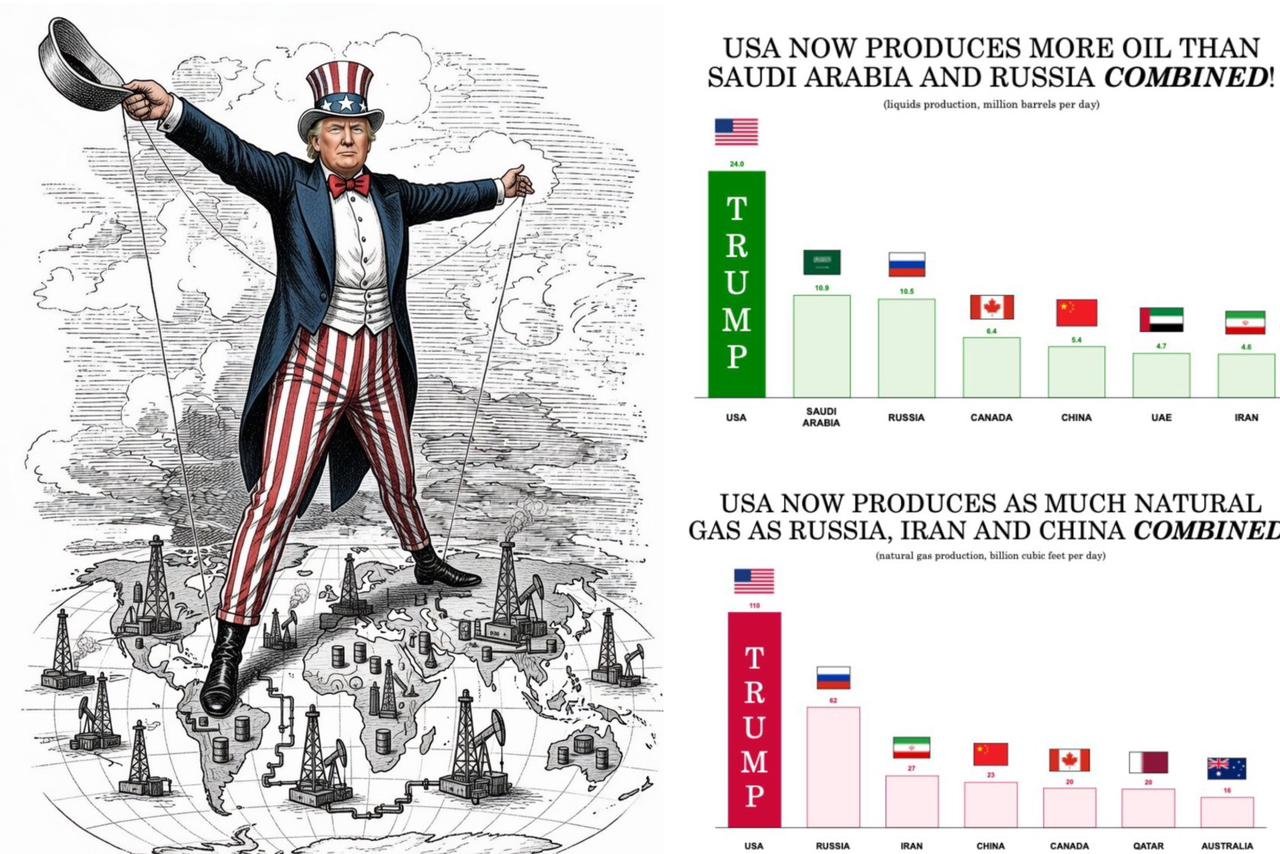
The United States is producing more oil than ever before in its history, with crude oil output reaching unprecedented levels in 2025 and holding strong into 2026 solidifying America’s position as the world’s leading energy producer while Europe grapples with the high costs of its aggressive green transition.
U.S. Crude Oil Production Hits All-Time Records
In 2025, U.S. crude oil production shattered previous highs, frequently exceeding 13.6 million barrels per day (bpd) and peaking at monthly records such as 13.84 million bpd in September. Official data from the U.S. Energy Information Administration (EIA) and Department of Energy confirm this as the highest annual average on record, with figures around 13.61 million bpd for the year overall. This surge was driven by technological improvements in shale drilling, particularly in the Permian Basin (accounting for roughly half of U.S. output), alongside contributions from New Mexico, Alaska’s new fields like Nuna and Pikka, and the Federal Gulf of America.
Monthly milestones included:
- July 2025: Record 13.6 million bpd
- June 2025: 13.58 million bpd
- September 2025: Peak 13.84 million bpd
These records mark a continuation of the shale boom that began over a decade ago, but recent policy emphasis on deregulation, infrastructure, and rapid permitting has accelerated growth. The U.S. has been the top global crude producer since 2018, but 2025’s levels represent a clear new era of dominance.
2026 Outlook: Near-Record Levels and Sustained Strength
Entering 2026, forecasts indicate U.S. crude oil production will remain near these historic peaks. The EIA projects averages of about 13.6 million bpd for the year essentially flat with 2025’s record before a modest decline to around 13.3 million bpd in 2027 due to lower oil prices curbing some drilling activity. Key drivers for stability include:
- Permian Basin holding steady at ~6.6 million bpd
- Gulf of America reaching a record 2.0 million bpd
- Alaska seeing gains from new projects
When including natural gas liquids (NGLs) and other petroleum products, total U.S. liquids production is even more impressive, projected at around 23.88 million bpd in 2026—representing nearly 22% of global output and far outpacing traditional heavyweights like Saudi Arabia and Russia combined in key categories.
This “more oil than ever” reality translates to tangible benefits: lower domestic gasoline prices (averaging around $2.90/gallon in early 2026, with sub-$3 in most states), boosted industrial competitiveness, job growth in energy states, and enhanced geopolitical leverage through reliable LNG exports to allies.
Europe’s Green Path vs. America’s Energy Muscle
While the U.S. flexes its energy muscles with record fossil fuel output, Europe continues down a challenging “green path” that prioritizes rapid decarbonization but often at the expense of affordability and industrial vitality. The European Green Deal and related policies have driven emissions reductions and renewable growth, yet they have resulted in electricity and gas prices 2–5 times higher than in the U.S., contributing to deindustrialization risks in energy-intensive sectors like steel and chemicals.
Europe’s heavy reliance on imported LNG (increasingly from the U.S.) creates new dependencies, while intermittency issues with wind and solar demand costly backups. Without pragmatic transitional fuels and subsidies, the pace risks stalling electrification goals and widening economic divides.
In contrast, America’s approach harnessing abundant shale resources alongside growing renewables delivers immediate advantages: cheaper energy for consumers and industry, surging exports, and strategic independence. As global energy needs rise with AI data centers, manufacturing, and electrification, the U.S. model of record production appears far more resilient and dominant.
The numbers tell the story: The United States isn’t just producing more oil than any other nation—it’s producing more than ever in its own history, powering economic strength while others navigate self-imposed constraints. This energy supremacy isn’t temporary; it’s a structural advantage in an uncertain world.
Also we need to remember that in 1973, the Arab oil embargo triggered by U.S. support for Israel during the Yom Kippur War plunged America into a profound energy crisis. Gasoline lines stretched for blocks, prices quadrupled, and the nation faced severe shortages that forced painful political and economic adjustments. For the first time in modern history, foreign oil producers wielded direct leverage over U.S. policy and daily life, exposing deep vulnerability from decades of growing import dependence.
From that low point onward, the United States has undergone one of the most remarkable energy transformations in global history, and the best is yet to come.