This strategy strikes at the structure of the Chinese navy itself. On paper the Chinese navy is the world’s largest by count. Yet a substantial portion of that fleet consists of small and medium surface combatants corvettes, patrol craft, and lighter vessels optimised for near seas presence and gray zone operations. These platforms were once an advantage in numbers and persistence. In the age of massed naval drones, they become liabilities. They lack the layered defenses of larger destroyers and carriers, and their sheer quantity creates more targets than a defender needs to prioritise. Western and even Russian fleets may be smaller in raw numbers, but they have historically showed quality, survivability, and integrated air defence. China’s earlier numerical edge in smaller craft is precisely the edge that low cost autonomous systems neutralize.
In every serious simulation of a Chinese assault on Taiwan, certain sequences appear with dark, destructive yet absolute consistency. Beijing opens with a massive barrage of short and long range missiles designed to saturate air defenses, cripple command nodes, and degrade Taiwan’s ability to respond. Simultaneously the People’s Liberation Army Navy uses its sheer numbers to seize the outer islands like Kinmen, Matsu, and others establishing forward bases and tightening the noose. Then comes the blockade, a ring of surface ships, submarines, and supporting forces intended to isolate the main island, choke its lifelines, and force a political collapse or set the conditions for amphibious landing. These are not optional flourishes in the planners’ playbook. They are the required opening moves.
Taiwan has long prepared one classic answer to the second and third phases: sea mines. For years the island has invested in rapid minelaying capability, expanding its Min Jiang-class ships and stockpiling modern mines that can be laid quickly in the approaches and littorals. The 2026 Han Kuang exercises continued this emphasis, testing rapid deployment, coastal barriers, and coordinated denial operations under simulated blockade and assault conditions. Mines remain cheap, persistent, and psychologically corrosive. They turn the attacker’s need for predictable landing zones and supply corridors into a liability.
What has changed and what Taiwan is now racing to master is the lesson of the Black Sea. Ukraine demonstrated that inexpensive, attritable unmanned surface vessels can inflict disproportionate losses on a larger navy. Russian ships that once dominated the waters around Crimea found themselves hunted by fast, low signature drone boats carrying warheads or loitering munitions. Ports were struck. High value platforms were damaged or sunk. The numerical and qualitative advantages of a conventional fleet were eroded by mass, surprise, and the defender’s home field knowledge of the battlespace.
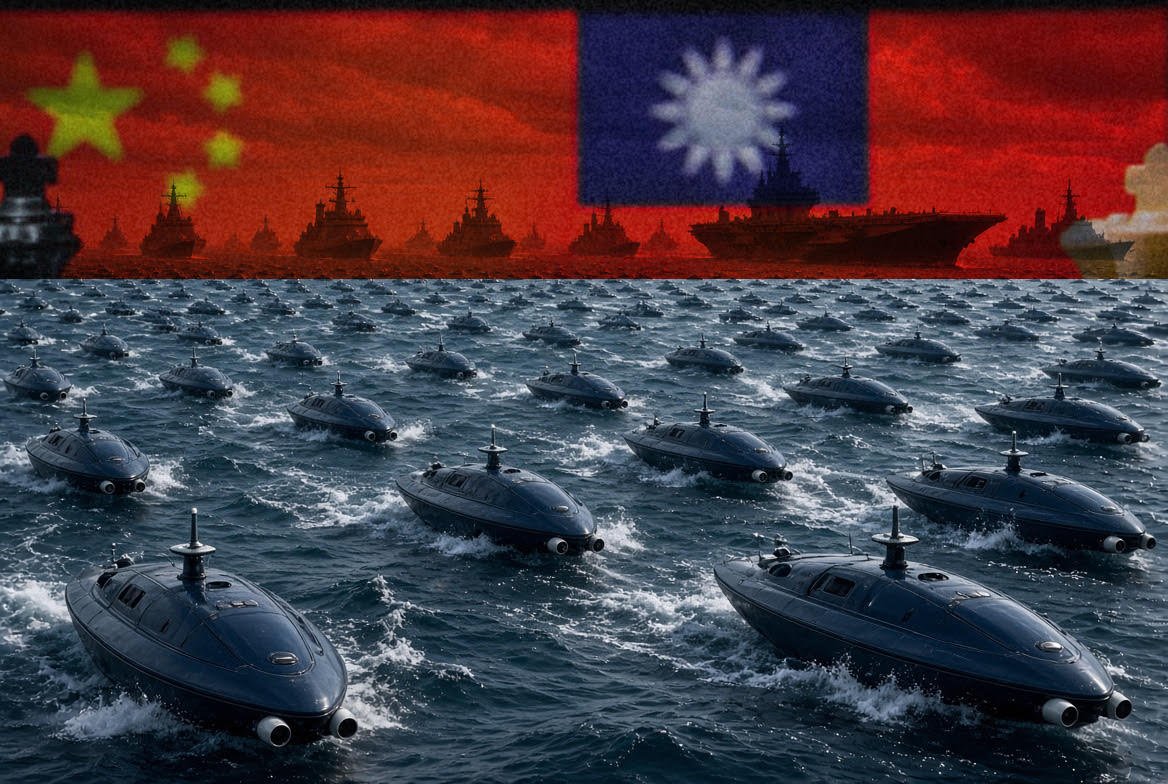
Taiwan has absorbed that playbook and is adapting it to the Taiwan Strait. The island is acquiring systems from Western partners and Ukraine while accelerating indigenous production. The Kuai Chi (also rendered Kuaiqi), developed by the National Chung-Shan Institute of Science and Technology, is a low-profile, container, transportable vessel capable of speeds above 40 knots. It can carry a bow warhead for ramming attacks, launch indigenous Jing Feng style loitering munitions, and operate with external targeting support. They are hoping for more than 1,300 units, with mass production underway or imminent. The Endeavor Manta, a stealthier trimaran design, emphasizes speed, reduced radar signature, and multi role flexibility, including the potential for swarm control of dozens of platforms by a single operator. Thunder Tiger’s Sea Shark series particularly the 600 and 800 variants has moved from concept to demonstrated capability. In July 2026 these boats, powered by Shield AI’s Hive Mind software, executed coordinated autonomous swarm operations, tracking, communicating, and forcing a target vessel without human control.
These are not isolated experiments. In August 2026 Taiwan’s NCSIST signed a memorandum with the American firm Vatn Systems for affordable autonomous underwater vehicles and AI command systems, explicitly framed as part of the broader “Hellscape” concept. Parallel work with Anduril, Maritime Tactical Systems, and others is expanding the undersea and surface layers. The goal is clear: flood the Strait with enough cheap, intelligent, expendable platforms that any Chinese surface force attempting to close the distance or enforce a blockade faces continuous attrition from multiple domains.
The United States has its own parallel track. The Hellscape vision articulated by successive Indo Pacific commanders envisions saturating the waters around Taiwan with thousands of unmanned surface, subsurface, and aerial systems. American plans call for large numbers of small USVs in the Indo Pacific by the end of the decade. Taiwan’s indigenous and co produced systems mesh with that concept, creating layered denial that does not depend solely on high end American platforms arriving in time.
This strategy strikes at the structure of the Chinese navy itself. On paper the Chinese navy is the world’s largest by hull count. Yet a substantial portion of that fleet consists of small and medium surface combatants corvettes, patrol craft, and lighter vessels optimised for near seas presence and gray zone operations. These platforms were once an advantage in numbers and persistence. In the age of massed naval drones, they become liabilities. They lack the layered defenses of larger destroyers and carriers, and their sheer quantity creates more targets than a defender needs to prioritise. Western and even Russian fleets may be smaller in raw numbers, but they have historically showed quality, survivability, and integrated air defence. China’s earlier numerical edge in smaller craft is precisely the edge that low cost autonomous systems neutralize.
The first serious naval exchange in a Taiwan contingency could therefore produce losses in a single day that exceed the cumulative surface ship attrition Russia suffered over months in the Black Sea. The attacker must sustain continuous logistics across contested waters. The defender operates from home territory, with shorter lines, better knowledge of currents and weather, and the ability to regenerate forces from dispersed sites. Every drone boat that forces a Chinese escort to expend missiles or divert attention raises the cost of the next wave. Supply ships and amphibious vessels become high value, high risk targets. The mathematical and operational burden falls heavier on the side that must come to the fight rather than the side that is already there.
None of this guarantees victory or makes a Chinese attack impossible. It does raise the price of aggression dramatically and complicates the carefully sequenced operations that Beijing’s planners prefer. Mines buy time and create chaos in the approaches. Autonomous swarms impose continuous attrition and force the attacker to dilute his defensive effort. Together they turn China’s numerical advantage into a vulnerability that must be managed at every stage of an operation.
Westvu War Simulation Incorporating the New Realities
Wrath of Red dragon ( Day one)
Chinese missile forces launch a heavy opening barrage. Hundreds of short and medium range ballistic and cruise missiles target air bases, radar sites, command centers, and major ports. Simultaneously, electronic warfare and cyber attacks attempt to blind Taiwan’s sensors and disrupt communications. Outer island garrisons on Kinmen and Matsu come under intense pressure from artillery, special forces, and small amphibious craft. Beijing’s narrative frames the operation as a “reunification” campaign rather than a full invasion, hoping to deter immediate American intervention. (Similar to Russia’s special military operation)
Mao vs Chiang Kai shek rematch ( Day two – Day seven)
PLAN surface groups and maritime militia vessels move to establish a de facto blockade on the western approaches while larger amphibious and logistics formations assemble. Taiwan activates pre-planned minefields in key approaches and chokepoints using Min Jiang-class minelayers and pre-positioned stocks. At the same time, multiple waves of Kuai Chi and SeaShark USVs launch from dispersed coastal sites and smaller harbors that survived the initial strikes. HiveMind-enabled swarms operate with limited human oversight, sharing targeting data and prioritizing high-value targets: Type 071 and Type 075 amphibious ships, logistics vessels, and any escorts that close within effective range.
Chinese escorts expend significant numbers of short-range missiles and close in weapon system ammunition against the first waves. Some USVs are destroyed. Others get through. Several medium sized amphibious or supply ships suffer damaging hits from ram charges or loitering munitions. Underwater vehicles begin seeding additional mines or conducting opportunistic attacks on slower targets. Weather in the Strait frequent fog, rough seas, and strong currents degrades the effectiveness of Chinese sensors more than it hinders the smaller, more agile Taiwanese platforms.
The blockade is only partially effective. Taiwan’s eastern ports and alternative supply routes remain open longer than Beijing planned. Chinese forces attempting to clear minefields or protect landing corridors face continuous low-level attrition. Every day that the amphibious force cannot land in strength increases the political and operational cost. U.S. and allied unmanned systems begin appearing in the outer layers of the battlespace under the Hellscape concept long-range surveillance and strike drones launched from outside the immediate missile envelope complicating Chinese targeting further. Beijing must decide whether to escalate by striking American or Japanese assets or accept a slower, bloodier campaign.
Likely outcome of this phase. China can still seize some outer islands and impose significant economic pain through partial blockade and missile damage. A rapid, low cost fait accompli against the main island becomes far less probable. Amphibious landing timelines slip. Logistics attrition mounts. The PLAN’s large inventory of smaller surface combatants proves more vulnerable than its larger capital ships. Taiwan’s losses are also heavy, many USVs and some coastal infrastructure are expended but the defender regenerates forces from dispersed production and stockpiles faster than the attacker can replace specialized amphibious and logistics vessels under fire.
This is not a prediction of Taiwanese victory. But they have significant capabilities to damage china’s decades long ambitions and go for a stalemate. This is indeed a victory to free world in a long run. This simulation also is an illustration of how the combination of mines, autonomous surface and subsurface systems, and geographic advantage can convert China’s quantitative superiority into a series of costly tactical problems. Any Chinese planner who assumes that mass alone will deliver a short, decisive campaign across the Strait is operating on outdated assumptions.
The coming years will show whether Taiwan can field these systems in the necessary numbers and integrate them effectively before the crisis arrives.