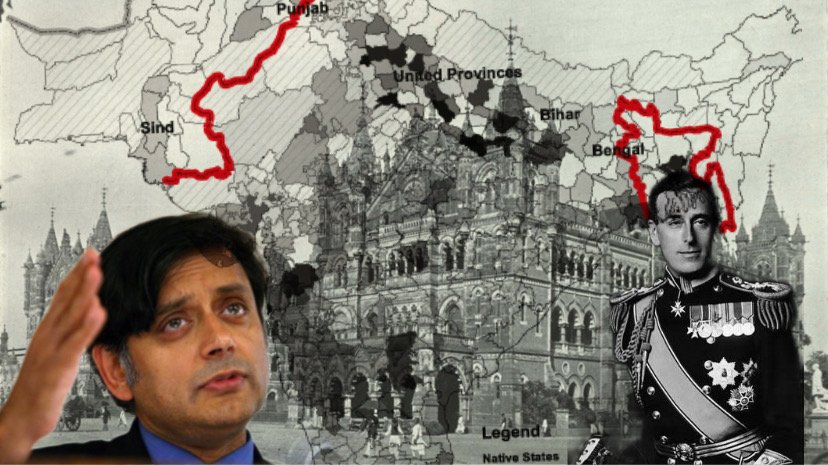
Shashi Tharoor (Mr. Victim ) has built his entire career, books like Inglorious Empire, Oxford debates, TV panels, and political legacy on one big story: The British Empire was the ultimate villain that stole $45 trillion from India, looted them dry, divided them with “divide and conquer,” rushed Partition through Mountbatten’s incompetence, and left them as eternal victims who should keep demanding reparations while hating and suspecting the West forever. It sounds accurate, brave and gets claps, but it’s mostly mythological lies mixed with selective history. No empire in the past was “charitable.” From Mongols to Romans, Spanish to French, Babylonians to Persians, Magadha to Kalinga, invaders and terrible Islamic caliphates all extracted wealth, used violence, and conquered. The British Empire was actually the most humane and pragmatic among them. They united India, built lasting infrastructure and skills they still use today, and left institutions that made modern India possible. True Indians should be grateful for the good they delivered, not stuck in victim mode. It’s time to drop this old Soviet-style blame game and adopt a pragmatic Singapore approach. The BJP under Modi is already showing the way and that’s a positive sign for India’s future.
Pre-Colonial India Was Never One Big United Nation.
Before the British, India was never a single country. Around 600 BCE there were the famous 16 Mahajanapadas.
- Anga
- Magadha
- Kasi (Varanasi)
- Kosala
- Vajji
- Malla
- Chedi
- Vatsa
- Kuru
- Panchala
- Matsya
- Surasena
- Assaka
- Avanti
- Gandhara
- Kamboja.
These were separate nations or republics always at war or making short alliances. Magadha grew strong and absorbed others, but full unity never lasted long. Mauryan and Gupta empires gave temporary big rule, but fragmentation always returned. Islamic rulers (Delhi Sultanate, Mughals) controlled large parts of the north and centre but never the whole subcontinent. The south had Vijayanagara, Cholas, and others fighting back.
By the time the British East India Company arrived and expanded in the 18th century, India was a mess of hundreds of independent or semi-independent states — Mughal remnants, Maratha Confederacy, Sikh Empire, Rajput kingdoms, and many more. At Independence in 1947 there were exactly 565 princely states covering about 40% of the land and 23% of the population. Without British paramountcy, a single civil service, railways, unified legal system, and English as a link language, there would be no modern India today. The British actually united the place into one administrative unit. Lord Mountbatten didn’t invent problems. He was the solution. He managed the final transfer in a crisis. Blaming him alone ignores centuries of reality.
The $45 Trillion “Loot” Is a Myth When You Break It Down Pragmatically
Tharoor keeps repeating Utsa Patnaik’s $45 trillion figure (compounded export surpluses from 1765–1938 at 5% interest). But this is not “pirate chests of gold stolen and shipped to London.” It mainly counts India’s overall trade surplus (exports bigger than imports) financed by Indian taxes through clever accounting like Council Bills. It includes normal trade, forced imbalances, home charges for British salaries and pensions, and even wealth created under British rule.
Tea plantations in Assam (British introduced commercial scale with Chinese seeds. India had only wild tea before), coffee, large-scale mining of coal, iron, manganese (pre-British was tiny artisanal stuff), jute, and more. These were new industries using British capital, technology, and global markets. Without Brits, those surpluses wouldn’t exist at that level. Taxes funded it, yes but that money also paid for real things left behind.
Infrastructure Built by Brits. Still Standing and Resilient Today
British built the world’s fourth-largest railway network by 1947 (around 65,000 km route), modern ports (Mumbai, Kolkata, Chennai), improved roads like the Grand Trunk, massive irrigation canals (irrigated area jumped 8-fold), bridges, cities, and defense cantonments. Many of these are still the backbone of India, strong British over-engineering means old bridges and stations survive monsoons and floods better than some new Indian constructions that collapse easily. Rebuilding equivalent railways today would cost hundreds of billions of dollars. Nominal investment was hundreds of millions of pounds (billions in today’s value), often with 5% guaranteed returns to British companies paid from Indian revenues. Part of the so called “drain.” But the assets stayed in India. They inherited them and expanded to over 69,000 km today.
Skills and Human Capital
This is often ignored. Railways alone employed over a million Indians by the end — created India’s first modern industrial workforce with skills in engineering, mechanics, logistics, and management. Brits set up engineering colleges (Roorkee etc.) and Western-style universities, law, and civil service systems. Pre-colonial India had great traditional knowledge but no large-scale industrial or bureaucratic framework for a subcontinent. This human capital let independent India build heavy industry and scale further. Value creation, not theft.
Hindu-Muslim Tensions and Partition — Tharoor Is Completely Wrong ( As Usual)
“Divide and conquer” existed as policy, but Hindu-Muslim problems started centuries before British arrival. Islamic invasions from Mahmud of Ghazni (1000 CE) brought temple destructions, jizya, massacres, and religious wars far worse than Raj-era incidents. Tensions were real and bloody long before East India Company. The Muslim League’s two-nation theory reflected fears of Hindu-majority rule.
Demographic proof it saved both sides. Specially Hindus. Today (undivided subcontinent estimate) total population ~1.8–1.9 billion. Muslims would be around 580–605 million (31–33%) — India’s current 200–210 million (14–15%) plus Pakistan and Bangladesh. Hindus around 60%. In 1901 Muslims were only 20–22%. Without Partition, India would face permanent majority-minority deadlock, coalition paralysis, and higher risk of civil wars plus linguistic fractures (Tamils and other southern groups would add extra layers of tension). Separate nations prevented a worse catastrophe. Mountbatten rushed the timeline (from 1948 to 1947), Radcliffe drew borders in five weeks. But still that prevented major civil war and Majority Minority chaos.
Sri Lankan Example Shows Tharoor’s Hypocrisy
Kalinga Magha from ancient Kalinga (today’s Odisha area in India) invaded Sri Lanka in 1215 CE with 24,000 mercenaries. He destroyed the glorious Parakramabahu era, sacked Anuradhapura and Polonnaruwa, wrecked temples, monasteries, irrigation systems, and wiped out the wealth of the Sinhala Buddhist golden age. 21 years of terror. Sinhalese civilization shifted south and never fully recovered in the north. Sinhalese are still suffering from that collapse. Yet Shashi Tharoor never demands India pay reparations to Sri Lanka for this Indian-origin destruction. No speeches, no books. Victim narrative only applies to British rule, This is classic selective history.
Tharoor’s Hypocrisy
He preaches strong anti-West, anti-colonial lines while his entire family lives the Western dream. Born in London, higher education in the US (Tufts/Fletcher School), children with global Western exposure. Reminds me of Iran’s Larijani family — hardline anti-West regime figures while sending kids to study and live in the West. Tharoor also openly urges Indian diaspora to use aggressive lobbying in the US and West for India’s interests (visas, trade, politics). Fine tactic, but it’s exactly the “Western” approach he criticizes elsewhere. Hypothetical when it suits his politics. Also he is cunningly select his audience to spread his mythological lies. Congress party voters, People who fell to USSR propaganda, Oxford liberals and other leftists in the UK and west. He knows that many of these people not going to see this through pragmatic lens, He used the word loot as a rage bite, He knows that this audience is not going to ask back the Story of Sri lanka and other hidden victims, what about other empires. Should everyone pay reparation to everyone.
Also another fascinating thing is Shashi Tharoor and many politicians have based their whole ideology and legacy on blaming British for everything and playing eternal victim. (This is exactly why the African American community lags behind compared to other ethnic groups. Thomas Sowell pointed this out several times.) It feels good but holds India back. British left railways, ports, cities, bridges, defense infrastructure, rule of law, English, and modern skills we still use and build on. Grateful for the positives doesn’t erase negatives. It means facing history honestly.
Singapore did exactly this. Took colonial legacies and moved forward pragmatically instead of crying forever. Old Soviet-style central planning, endless blame, and victim cards don’t build nations. Positive sign is the BJP administration under Modi is shifting to this pragmatic path. Massive infrastructure push (building on British base and adding more), reforms, global engagement without constant victimhood, Pro west approach, and focus on results. That’s the right direction for true Indians.
India’s real story is layered. Ancient fragmentation, conquests, adaptation, and progress. Brits united a divided land, modernized it imperfectly, and left durable assets. Move on from mythological lies. Be grateful where due, build stronger, and focus on the future. That’s how winners think.